
(Painting of livery stable owner Thomas Hobson, the originator of the phrase "Hobson's Choice," courtesy of Wikipedia)
(Originally posted on Speaking to the Soul, Sunday, August 21, 2011)
2 Samuel 24:1-2, 10-25:
Again the anger of the Lord was kindled against Israel, and he incited David against them, saying, “Go, count the people of Israel and Judah.” So the king said to Joab and the commanders of the army, who were with him, “Go through all the tribes of Israel, from Dan to Beer-sheba, and take a census of the people, so that I may know how many there are.”
But afterward, David was stricken to the heart because he had numbered the people. David said to the Lord, “I have sinned greatly in what I have done. But now, O Lord, I pray you, take away the guilt of your servant; for I have done very foolishly.” When David rose in the morning, the word of the Lord came to the prophet Gad, David’s seer, saying, “Go and say to David: Thus says the Lord: Three things I offer you; choose one of them, and I will do it to you.” So Gad came to David and told him; he asked him, “Shall three years of famine come to you on your land? Or will you flee three months before your foes while they pursue you? Or shall there be three days’ pestilence in your land? Now consider, and decide what answer I shall return to the one who sent me.” Then David said to Gad, “I am in great distress; let us fall into the hand of the Lord, for his mercy is great; but let me not fall into human hands.” So the Lord sent a pestilence on Israel from that morning until the appointed time; and seventy thousand of the people died, from Dan to Beer-sheba. But when the angel stretched out his hand toward Jerusalem to destroy it, the Lord relented concerning the evil, and said to the angel who was bringing destruction among the people, “It is enough; now stay your hand.” The angel of the Lord was then by the threshing floor of Araunah the Jebusite. When David saw the angel who was destroying the people, he said to the Lord, “I alone have sinned, and I alone have done wickedly; but these sheep, what have they done? Let your hand, I pray, be against me and against my father’s house.”
That day Gad came to David and said to him, “Go up and erect an altar to the Lord on the threshing floor of Araunah the Jebusite.” Following Gad’s instructions, David went up, as the Lord had commanded. When Araunah looked down, he saw the king and his servants coming toward him; and Araunah went out and prostrated himself before the king with his face to the ground. Araunah said, “Why has my lord the king come to his servant?” David said, “To buy the threshing floor from you in order to build an altar to the Lord, so that the plague may be averted from the people.” Then Araunah said to David, “Let my lord the king take and offer up what seems good to him; here are the oxen for the burnt offering, and the threshing sledges and the yokes of the oxen for the wood. All this, O king, Araunah gives to the king.” And Araunah said to the king, “May the Lord your God respond favorably to you.” But the king said to Araunah, “No, but I will buy them from you for a price; I will not offer burnt offerings to the Lord my God that cost me nothing.” So David bought the threshing floor and the oxen for fifty shekels of silver. David built there an altar to the Lord, and offered burnt offerings and offerings of well-being. So the Lord answered his supplication for the land, and the plague was averted from Israel.
Today's Hebrew Bible reading sets a chronological precedent in the story of "how people deal with God's will." Gad the prophet reveals for the first time in the Hebrew Bible that people are offered alternative choices in dealing with the Almighty. Prior to 2 Samuel, the standard operating procedure with God is "God speaks in some way, and the intended recipient either does it or doesn't do it." But what we come to discover in this reading is that these choices are really more of a Hobson's Choice than they are choices of free will.
Granted, these are not attractive choices. In my mind, David's choices for what to do with Israel run like this: 1) Punish everyone in Israel with three years of famine; 2) David can take the blame himself and be on the lam for three years; or 3) put Israel through three days of pestilence. One thing is clear: At this point, David is not ready to take the blame himself. He chooses "The hand of the Lord" (1 Samuel 5:6 establishes that this is a synonym for "plague") and, at that point, chooses to save his own hide. Some commentaries call this "David's strategy;" truthfully, I think that is rather charitable to David. He's been on the run before; it's not fun, and frankly, my gut reaction to his choice is that he's preserving his own skin, but he sort of lessens his guilt by picking three days over three years.
But what we discover, as the story unfolds, is when the angel of destruction appears on the scene, two things happen. First, God essentially says to the angel, "Sit tight a minute; let's not rush to judgment." This pregnant pause moment is all David needs to finally come around to his understanding of his own sins and the full meaning of the weight of his authority over the people of Israel. The sight of imminent destruction of innocent people gets David to finally come around to admitting, "I did it, this is MY fault," and he responds by making the appropriate sacrifices, even paying a fair price for the real estate for his altar, rather than simply having it given to him because of his power differential.
My gut feeling in this story is that it wouldn't have mattered which option David would have chosen--the outcome would have been the same. Eventually, David would have come around and chosen to accept the responsibility and make the appropriate sacrifices. Only the in-between in this story would have changed. I think about all the times we stress over "making the right decision" in our personal prayer lives, that somehow, we get into this delusion that we have power over God through our choices. We tend to discount the possibility that, no matter what we choose in our decisions over the most worrisome aspects of our lives, that God is perfectly capable of using the Hobson's Choice option on us--that no matter what we choose, we will eventually choose "taking it" over "leaving it," because we desire a relationship with God and God desires a relationship with us.
The various David stories in both books of Samuel are reminders that all of us, as God's anointed, do some really stupid things sometimes--we all sin, and we all have stories in our lives that we wish we could climb into that Back to the Future Delorean and change. But we don't get that option. We only get the option to move forward from where we are, with God's help. Today's story reminds us that even our wrong choices can, eventually lead to the right one.

(Present day view of the site of the Temple of Artemis in Ephesus, courtesy of Wikimedia Commons)
Acts 19:21-40:
Now after these things had been accomplished, Paul resolved in the Spirit to go through Macedonia and Achaia, and then to go on to Jerusalem. He said, “After I have gone there, I must also see Rome.” So he sent two of his helpers, Timothy and Erastus, to Macedonia, while he himself stayed for some time longer in Asia. About that time no little disturbance broke out concerning the Way. A man named Demetrius, a silversmith who made silver shrines of Artemis, brought no little business to the artisans. These he gathered together, with the workers of the same trade, and said, “Men, you know that we get our wealth from this business. You also see and hear that not only in Ephesus but in almost the whole of Asia this Paul has persuaded and drawn away a considerable number of people by saying that gods made with hands are not gods. And there is danger not only that this trade of ours may come into disrepute but also that the temple of the great goddess Artemis will be scorned, and she will be deprived of her majesty that brought all Asia and the world to worship her.” When they heard this, they were enraged and shouted, “Great is Artemis of the Ephesians!” The city was filled with the confusion; and people rushed together to the theater, dragging with them Gaius and Aristarchus, Macedonians who were Paul’s travel companions. Paul wished to go into the crowd, but the disciples would not let him; even some officials of the province of Asia, who were friendly to him, sent him a message urging him not to venture into the theater. Meanwhile, some were shouting one thing, some another; for the assembly was in confusion, and most of them did not know why they had come together. Some of the crowd gave instructions to Alexander, whom the Jews had pushed forward. And Alexander motioned for silence and tried to make a defense before the people. But when they recognized that he was a Jew, for about two hours all of them shouted in unison, “Great is Artemis of the Ephesians!” But when the town clerk had quieted the crowd, he said, “Citizens of Ephesus, who is there that does not know that the city of the Ephesians is the temple keeper of the great Artemis and of the statue that fell from heaven? Since these things cannot be denied, you ought to be quiet and do nothing rash. You have brought these men here who are neither temple robbers nor blasphemers of our goddess. If therefore Demetrius and the artisans with him have a complaint against anyone, the courts are open, and there are proconsuls; let them bring charges there against one another. If there is anything further you want to know, it must be settled in the regular assembly. For we are in danger of being charged with rioting today, since there is no cause that we can give to justify this commotion.”
One of the readings from Acts in the Daily Office a few weeks ago was this story. It's always a fun and slightly pithy one for me.
Paul's in trouble again, and it's because all his preaching and teaching has caused a bit of a lull in the Silver Souvenirs of Artemis trade. The folks in the souvenir trade got other folks all whipped up, (probably even a bunch of people who couldn't even afford a silver Artemis for the living room or kitchen table) and it took a wise and silver-tongued town clerk to calm folks down.
Well, and when it was all said and done, as you can see by the photo above, the religion of worshiping Artemis didn't withstand the test of time.
My fellow Joplin volunteer pal Christian posted this interesting article about the church and the language of grief and lament that really caught my attention a few days ago. In fact, in the last couple of years in particular, there's been a huge amount of press-inches devoted to various permutations of "The Death of Christianity," and "Is Christianity Dying?"
Well, to that I say, yes...and no.
I believe the church as America knew it in the 1950's is dying, if it isn't already dead.
I believe the church as a social organization is dying.
I believe the biggest thing holding back established churches at the moment is the maintenance of huge barns of buildings that they can no longer afford to keep up, heat, and cool--especially in small towns.
But here's what else I believe, based on a lot of reading and discussion:
I believe millennials desire God as much as any generation prior--but it has to be real and relevant to their experience. Many did not grow up as regular church or Sunday school attendees. My generation at least knew how to "go through the motions." But honestly, if I was a 20something, and my choices were, "God as evangelical Christianity portrays," vs. "atheism," I'd choose atheism. I don't think we tout nearly enough that there are other options, and so no one knows what we have to offer very well.
I believe that the more we begin to shed ourselves of the burden of maintaining too-big sanctuaries, and become more like the Early Church, we will find people who desire God and we, the already churched, will become more comfortable with change.
I believe the more we empower the laity, the more we get the laity in touch with their own fundamental priesthood as it relates to our Baptismal Covenant, the more tolerant we will become of change, both great and small, because we will feel "invested."
I believe that the more each of us begins to live the life of a baptized Christian, rather than a "churchgoer," we will become more tolerant of one another's human-ness, including the human-ness of our ordained clergy. What they do and how they do things with the little liturgical details in terms of their own personal piety won't matter as much, and we'll begin to get off our "But that's how we've always done it."
But the scary part is I believe in some ways, the church will have to die to itself in order to be reborn.
I think about the "little things" that my own parish has over-focused on in the past, and how we've over-focused on the priest as the engine of the liturgy in times past. I still remember the first time as acolyte in our interim period, and our interim had me behind the altar, looking out at the pews instead of to the side, looking at the priest. It slammed into me like a cinder block for the very first time that it wasn't the priest that makes the Eucharist happen, it's us. Granted, the priest has an incredibly important role as presider, as the person who sacramentalizes the process. But the fact remains--you can't have a Mass for one, even if the "one" is a priest.
In short, we have to stop treating the building, the priest, and the "way we've always done it" like silver souvenirs of Artemis.
I imagine the Artemis-worshipers of ancient times treated those little silver statues a little too magically now and then. Relying on magic, rather than the incarnation within each of us and the relational aspect of that to God, frankly, makes the experience less real. It takes us out of the loop as active participants.
But what I'm proposing--this notion that each of us needs to gain an awareness to our own fundamental priesthood--well, it can be dangerous business and filled with heavy uncertainty. It's also, sadly, very threatening to ordained folks who are not comfortable with their own fundamental priesthood or hide behind their ordained priesthood as a vehicle to fulfill their own inadequacies. My experience has been that clergy who are very comfortable with who they are in their own fundamental priesthood are not threatened at all by a lay person with a strong sense of his or her own fundamental priesthood.
The flip side is that laypeople who are not in touch with their own fundamental priesthoods, or are uncomfortable with them, lay things on the clergy that they should be taking care of themselves in terms of their spiritual growth. Seeing the priest as a magical shaman rather than an icon of our own priesthood causes laity to blame the priest for the oddest things.
I think back to the time of the Book of Acts. Paul had to put a great deal of trust in many, many empowered laity. Granted, he was not "ordained" in the sense we now think of it, but the geography and nature of his travels demanded an early church that had to understand their own priesthood as individuals. They could not depend on silver statues of Artemis to make things right.
Yes, there were mistakes. Big ones. But we still all make big mistakes in the name of the church--laity and clergy alike--and perhaps a better tack is to simply keep the dialogue going, and continue to worship together, rather than huddle up in little groups and stir people up like the silversmiths did.
Not long ago, I was involved as part of a "think tank" in helping a parish begin to facilitate a solution to some very serious problems they were having. Now, I doubt I know a single person in it, and they most certainly have no clue who I am, or that they even knew I was involved. What I discovered, as this "think tank" turned its gears, was that it required me to discuss my own learning regarding some of my own huge mistakes in life. I found myself filled with an odd sense of gratitude. What I had started out learning for my own sake, could actually be put to use to help others. Living through my own mistakes had value beyond myself.
An amazing thing happened. I found myself truly invested in people I didn't even know--not in the outcome, mind you--that's their row to hoe, not mine--but simply in the life and spiritual health of these people I would not know on the street if I walked by them. I found them in my prayers, and in my musings--and I found myself truly wishing them well, and asking God to give them every good thing that had been given to me--including the ability to learn from mistakes.
This, to me, is part of what being an institutional church is all about. Yes, we have an individual relationship with God, but it is our corporate life that is sacrosanct. We have to toss our silver statues of Artemis aside and stop believing in magic that gets showered down from above. We have to get our hands dirty and our noses bloodied. We have to care about people we don't even know.
Ultimately, I believe the church will survive--and not just survive, but thrive. But to do it, we have to be willing to change ourselves first, and not just holler for the church to change.

("Walking trees" along the shore of Loch Lochy, courtesy of Wikimedia Commons)
Mark 8:22-33:
They came to Bethsaida. Some people brought a blind man to him and begged him to touch him. He took the blind man by the hand and led him out of the village; and when he had put saliva on his eyes and laid his hands on him, he asked him, “Can you see anything?” And the man looked up and said, “I can see people, but they look like trees, walking.” Then Jesus laid his hands on his eyes again; and he looked intently and his sight was restored, and he saw everything clearly. Then he sent him away to his home, saying, “Do not even go into the village.” Jesus went on with his disciples to the villages of Caesarea Philippi; and on the way he asked his disciples, “Who do people say that I am?” And they answered him, “John the Baptist; and others, Elijah; and still others, one of the prophets.” He asked them, “But who do you say that I am?” Peter answered him, “You are the Messiah.” And he sternly ordered them not to tell anyone about him. Then he began to teach them that the Son of Man must undergo great suffering, and be rejected by the elders, the chief priests, and the scribes, and be killed, and after three days rise again. He said all this quite openly. And Peter took him aside and began to rebuke him. But turning and looking at his disciples, he rebuked Peter and said, “Get behind me, Satan! For you are setting your mind not on divine things but on human things.”
Out of all the healing stories in the Gospels, this is one of my favorites, for two odd reasons. One is simply that Jesus had to make two runs at healing this blind man.
From a medical standpoint, I wonder if the man was blind from Chlamydia trachomatis, aka trachoma. It's often inherited trans-vaginally during the birth process (one of those "sins of the father/mother" sorts of things) and causes granules to form on the cornea. Before the advent of antibiotics, most "cures" involved physically removing the granules in some way.
In fact, I'd put my house payment on that was what was wrong with the guy, and oddly, my comfort with that speculative knowledge gets me flak from both ends of the religious/non-religious spectrum at times. My non-religious friends point with glee that there was no miracle at all, it was an ordinary medical cure of the time. My more evangelical friends tsk-tsk and shake their heads at me that I don't believe it was a "miracle." Neither end does my feelings about this justice.
First of all, a miracle does not have to be defined in terms of a magic trick. Modern medicine produces miracles all the time. What we now think of as simple garden variety generic antibiotics, at the time they were introduced, were, indeed, miracles. They alleviated death and suffering in a way not previously known. It's just a fact that yesterday's miracles are today's old news. In fact, a lot of antibiotics are no longer miraculous when it comes to certain organisms, because the bacteria have become resistant. I really believe there is a temporal aspect to miracles. They are miracles because they happened in a frame of time or history that this was not the expected outcome.
Second, knowing and believing there is a scientific principle to the healing miracles of Christ does not cheapen or dilute them in any way. Part of the miracle in this story is that mostly, the world in that place or time did not bother themselves with blind people. For Jesus to stop and interact with that man is another form of miracle--to see humanity in a way different than the typical rank and file person on the street.
But oddly, I really really like that it took Jesus two runs at curing this man's blindness.
I don't like some of the theological takes in this story that the reason it took two tries was because of some perceived lack of faith in the blind man. There's nothing in this story that even hints that the blind man is skeptical or unfaithful. I mean, for crying out loud, all the man did was admit the truth--that he could see a little but not a lot.
I honestly think it took two tries because it simply took two tries to remove enough of the granules...and there's no harm or denigration of Jesus because of that.
I think of my own relationship with God, and the true healing I've experienced in this relationship...and I can't think of a single time God did anything "healing" to me that got accomplished in one shot. Or two, for that matter. I think we are talking many, many runs at me to get me healed. Yet I feel healed by the grace of God just the same. I don't sit around and grump about "Well, gee. If God's grace were really worth a damn, he would have fixed this the first time."
Seems to me that we need a Jesus who is persistent enough to take more than one run at us, in our spiritual and psychological blindnesses. Honestly, I don't need a Jesus who takes a powder when I don't straighten up the first time, or dumps it back on me for not being faithful enough. That's not a loving relationship. That's abuse of power.
The other thing I like about this story is simply that the blind man spoke up that he was better, but not cured. I am so used to making do with the leftovers. I've told the story to you before about how it was well into my teenage years that I discovered most people think of over-easy eggs as the "good" fried eggs and the broken yolk ones as "failures." I have always been used to not getting the best product, being okay with the store brand instead of the name brand, and getting the "good" brand as a closeout or overstock. It seems to me the blind man had a pretty difficult choice to make in terms of speaking up or not. It would have been easy to think, "Well, I'm less blind than I was, so I guess I'd better shut up and say that's good enough." We forget that the blind in this era were not just visually handicapped, they were ostracized, ignored, and blamed for their own "sins" or carrying their parents' sins.
But our man in the story spoke up and told the truth. "Wow, it's better, but these people don't look like people. They look like trees walking." He gave Jesus accurate feedback which shaped Jesus' next move. I am impressed he did that. What right did an outcast of the times have to tell the great healer, "It's still not quite right?" Well, in the secular world of the day, none. In the religious world of the day, pretty much none, also, because it was clear people with infirmities were "unclean" in some way--that is why they could read the Torah in public or stand at the bima. I have to hand it to him for that.
It begs a great question. What do we do when we begin to "see" things in a new or undiscovered way? Do we settle for what we get, or do we speak up? Have we ever considered the possibility that God desires honest feedback from us, and is big enough to handle it?
It took me many years to be comfortable "praying angry," or "praying hurt," and it took me forever to even broach "praying when I was sobbing so hard any innocent bystander wouldn't have understood a word I said." For so long, I felt I had to be all emotionally squeaky clean when in the presence of the Almighty--that I had to use complete sentences and sound prayerful and look grateful. I am still no good at all doing that in the presence of other people, but I'm at least comfortable doing it off by my lonesome. I think it is because there were people in my family that if you cried, you became vulnerable and that set you up for being attacked, or the flip side--there were people in my family that if you did not "cry to their specifications," your feelings were somehow not as valuable, and they, the emotional, tearful ones in the family, well...their feelings were more important than yours then.
Cry and be stabbed and left by the side of the road for it, vs. don't cry and be devalued over the one crying. What a dilemma!
But as we learn to pray angry, pray hurt, pray with tears, and pray when we smell our own decomposition in our noses, something happens. We become less afraid to admit "Well, I only see people that look like trees, walking." When we work with a Jesus whom we discover doesn't mind a bit to take two, three, or 327 runs at us, we stop insisting on "all or nothing" as the result of our prayers. We stop clinging to the "my way or the highway" position for the difficulties in our life, and start engaging in a two way relationship with God--and even if the best it will ever be will be to see people like trees, walking, we discover we are not alone in our semi-blindness.
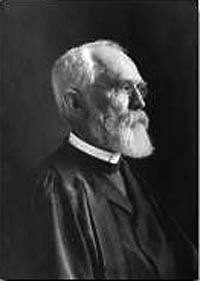
(Photo of William Porcher Dubose from the Holy Women, Holy Men blog)
Almighty God, you gave to your servant William Porcher DuBose special gifts of grace to understand the Scriptures and to teach the truth as it is in Christ Jesus: Grant that by this teaching we may know you, the one true God, and Jesus Christ whom you have sent; who lives and reigns with you and the Holy Spirit, one God, now and for ever. Amen.
--Collect for the Feast Day of William Porcher Dubose, Holy Women, Holy Men, p. 533.
William Porcher Dubose, whose feast day was August 18, seems to be a rather interesting character in our liturgical calendar. One one hand, he is considered one of the giants of theology in the early days of The University of the South (aka Sewanee.) He was one of the people who shaped the "Big Tent" theology of our modern Episcopal Church. He was virtually unknown as a theologian until age 56, yet his books still sell to this very day on Amazon.com and get high reader reviews.
On the other hand, he was a Southerner--and I mean a Southerner--in every sense of the word. He was an officer in the Confederate Army (there's a great story about him baptizing General John Bell Hood not long before he was killed by a shell.) He lived in the south during Reconstruction, and sadly, there is some speculation (although unproven) that he could have been a member of the Ku Klux Klan during the Reconstruction period. This allegation is rather unclear, and I honestly don't know if it is true or not, but it's enough of an allegation that there's been discussion about whether he should be removed from the liturgical calendar.
My gut feeling, though, is even if the allegations were true, leaving him on the calendar might be a wonderful testimony to the tension in which me must all live as Christians, and the unease we have to accept about some brutal mistakes we have made in the name of Christianity. I often think about what my atheist friends try to hang on me as a practicing Christian. They seldom want to fight with me and my personal theology. They seem, however, to be hell-bent for leather to make me feel some kind of guilt for every war, every aspect of oppression, that was condoned by the church or perpetrated by Christianity. It's impossible for me to accept that guilt, because, frankly, I didn't do it. I have compassion for how the church has wronged people over time, but the church is not the only oppressor of society, so is government, capitalism, etc., and I can't feel any more guilt over the church than I can feel for, say, American Imperialism.
It seemed no small coincidence that on the feast day of William Porcher Dubose a pile of interesting discussions broke out on Facebook regarding the recently released movie, "The Help." Elizabeth had posted this story on her blog, and also on the Episcopal Women's Caucus Facebook page. Religion Dispatches had posted this piece, which Jane Redmont had shared. NPR had posted this and this.
Now, I do plan to see the movie. But I also plan to participate in a discussion we will be having at Trinity-Kirksville about the movie. It's been my heritage to see things for myself. Years ago, my late grandmother specifically went to see The Last Temptation of Christ because it had been denounced from every pulpit in Macon, MO. (Her verdict? "I don't know what all the fuss was about. There was this dream scene where he imagined being married to Mary Magdalene and having children. Well, duh, if you were about to be crucified, wouldn't you want an escape option?")
The controversy about this movie reminds me of another controversy from years past, involving the actress Hattie McDaniel. She was the first African-American actress to win an Oscar--but these days, what she got an Oscar for is reprehensible--she got it for playing Mammy in Gone With the Wind. In fact, as time went on, Hattie caught a lot of flak for playing mammies and maids from groups like the NAACP. Yet, at the same time, she was a quiet champion for civil rights--helping overturn restrictive covenants in a neighborhood in Hollywood, and a well-paid, working actress and radio star at a time many African-Americans could not find a job with dignity. I find it interesting that she was a trailblazer in so many ways but regarded as a traitor to others. She had to find her own way in a stormy place...as, I suppose, did William Porcher Dubose, and each of us in different ways.
I carry my own version of this storm. My great-grandfather was known as a fair man when it came to dealing with the African-American community. He owned and raced harness horses, and often hired black horse trainers. Yet he could not let his best drivers race, because only white men could be drivers at the racetracks he frequented. On the other hand, he was the city marshall, and in the 1920's when there was a lynching in my home town, he did nothing. Nothing. Honestly, I suppose that was because as one man, there was nothing he could do, even behind the badge of the law.
But what that storm did was shape my grandmother and mother. My grandmother was an election clerk, and she tolerated no foolishness nor shenanigans when it came to letting everyone who was eligible to vote, vote. My mother was a junior in high school when the high school integrated, and she was one of the people who made the "newcomers" feel welcome. I've posted before on my own life about my favorite elementary teacher, Mrs. Ella Smith, and how this amazing African-American lady and I shared the school year of 1967-68. That was quite a year to share a classroom.
I don't think there's any right answer to what impact the movie "The Help" will have on race relations, if it has any at all, but I am not a fan of boycotting something on someone else's principle. Telling someone to boycott something, to me, smells of someone saying I'm too stupid to make up my own mind about something. Now, that doesn't mean I won't make a terrible mistake. I've made terrible mistakes in the past. I've eaten crow for many things. But if I trust in the power for God to make all things well, and the realm of God to emerge, I have to trust in the power of the storm and the tension of it.
I don't think there's a cure or an answer to how to deal with this tension that still exists in our society between black and white, but I know I have power as an individual to spread the love of Christ. I think about a young African-American man who is one of my medical students. Recently, his mother unexpectedly passed away. He grew up in "the hood" in L.A. He's had to come so far on such a hard road. He came by my office asking my advice on some things and I also told him he was in my prayers and, at the end of the visit, I gave him a big hug. There was a day in my lifetime that hugging a young black man was an unthinkable, unspeakable thing. I know things are not changing fast enough, but they are changing. I can only trust in God to help me live in the tension of it.

(Little Eddie and Boomer waste no time getting on the new bed!)
Psalm 63:
O God, you are my God, I seek you, my soul thirsts for you; my flesh faints for you, as in a dry and weary land where there is no water.
So I have looked upon you in the sanctuary, beholding your power and glory.
Because your steadfast love is better than life, my lips will praise you.
So I will bless you as long as I live; I will lift up my hands and call on your name.
My soul is satisfied as with a rich feast, and my mouth praises you with joyful lips when I think of you on my bed,
and meditate on you in the watches of the night; for you have been my help, and in the shadow of your wings I sing for joy.
My soul clings to you; your right hand upholds me.
But those who seek to destroy my life shall go down into the depths of the earth; they shall be given over to the power of the sword, they shall be prey for jackals.
But the king shall rejoice in God; all who swear by him shall exult, for the mouths of liars will be stopped.
Well, at the time I read this, I thought, "I would meditate on my bed...if I had one." As part of the whole house remodeling thing, I slept on my couch from Feb. to August.
Then came the part where I actually bought a bed--a nice bed, a storage bed from Ashley Furniture, and could not use it until I got the new bedroom finished.
I had been "Mostly ok" with sleeping on the couch until I bought the bed. Then I got itchy to sleep in it.
Finally, the day came that I could move the bed in. I looked forward to sleeping in it...then I discovered...well...they hadn't sent all the pieces...namely the frame.
Agggh.
I loved how my friend Janie broke it to me. She called me at work (she was meeting the furniture store guys) and tells me how wonderful the headboard is and how sturdy the drawers were, and the mattress is comfy...and I finally realized she was holding out on me and I said, "But...????"
It was only then that she informed me the frame was AWOL.
At that point, I had a decision. Throw down the mattress and sleep on it? Or wait till the rest of the bed came in?
I opted for "wait." I decided that, given the fact I had never had a new bed in my entire adult life, sleeping on the mattress prematurely would sort of be like having one's first sexual encounter in the back seat of a '71 Chevy Impala. I had dreams of how my first night in my first new bed was supposed to be, and getting impatient would just ruin it.
When the rest of the bed came in, it was apparent it would be worth the wait.
So now I have a bed for pondering.
One of the places where I think we slip up in our prayer lives is it is probably our tendency to be pondering all the difficult things in our beds, staring at the ceiling. But how many times do we ever do like the Psalm suggests--pondering on our bed with joyful lips for God? Probably a lot less than the former scenario.
These days, my most joyful bed musing is gratitude for having a bed. My wonderful comfy mattress reminds me to be grateful. Much of the world sleeps on a straw mat. I don't mean that in a "boy, I'm lucky, look what I've got" sort of way but more in a "What can I do that can help others have a bed?" way.
What can we do for those displaced from their beds because tornadoes or floods whisked them away?
What can we do for those who have willingly left their bed and would live in fear if they returned to it?
What can we do for those who live in the parts of the world where almost no one has a standard American bed?
Yep, there's much to ponder on my bed!

"Remember, every connection holds within it a seed of holiness, which is the potential to notice the God who makes all connections possible. In my experience, successful practice of God's presence online has derived exclusively from cultivating these connections and properly attributing them to God's movement."
--Adam Thomas, from "Digital Disciple"
I thought the lunch Elizabeth packed me for my train trip home tells it all. Seeing it was a HUGE "gee whiz, aw shucks" moment for me. Seriously, I think the last time anyone "packed me a lunch," I was ten years old. I learned at an early age to make my own. Much of the pleasure of my train trip home was to savor the little snacks she put in there.
One of the things I dearly love about taking the train is I have hours and hours to be both social and quiet...but I particularly like the quiet. It's unencumbered time to think and reflect and read. My little bag of traveling food reminds me of the wonderful intersection of the IRL (" In Real Life") world and the virtual world that social networking has, if we are bold enough to embrace it.
I have been meeting various Facebook friends, mostly those connected to the spirituality blogging and "Episco-geek" world, for over three years now. When I have taken long trips to visit them, I have some fun playing a little bit of "Where in the World is Carmen Sandiego" with the trip, on Facebook. The visits have always been rewarding and uplifting, and there is a real closeness that deepens with these people, who, were, already, in some ways, close.
The spiritual blogging community is an interesting critter indeed. Many of us started our blogging careers under semi-anonymity, and in looking back I don't know if that was because we thought we weren't going to be any good, or because what we were doing at the time felt too much like someone reading our diaries in public. I suppose many of us started blogging because we weren't always being fed in our churches, or we had a growing spirituality we didn't always understand. I don't think any of us thought we were God's literary gift to the church. But we started feeding each other somehow.
As Facebook got more popular, we started de-cloaking a bit via Facebook and got to know each other, from a distance, anyway. Elizabeth's blog was one of the first ones I started reading on a regular basis. Her self-revealing style gave me confidence to start telling my own stories in a more authentic way, and I am still appreciative of that. I didn't use to think any of my stories had any healing value for anyone other than me. She made me think otherwise about that. I came to appreciate it's not so much about my stories, per se, it's that there is a universality to all our stories. A story about my life may be close enough to someone else's, and in hearing mine they may find a handle on theirs...then they can begin to tell their stories, who will be heard by others, etc., etc.
So seeing that lunch bag took things full circle, with "being fed." It struck a huge chord with me, with what it is we bloggers are trying to accomplish. I don't think we write because we are frustrated unpaid writers, I don't think we write because we have big egos and want to splash them all over the Internet, I think we write because we want to feed people, with God's help. There is simply a place where our wordsmithing from a distance makes us hungry to share physical time and space with these people in real life. God's movement through cyberspace creates real connections, that, if we can manage to trust in that power enough to take a car or train or plane trip, can lead us to a new form of "family."
I always come away from these trips feeling like I've discovered a long lost relative--a relative in the Family of God--and if a blog or Facebook page can lead us to God's presence and a real sense of family, it's not much of a stretch to believe God sees us as "in the family."

(Paul confesses Christianity in front of the Sanhedrin, from St. Peter and Paul Church in Tyrol, courtesy of Wikimedia Commons)
(This post originally appeared in the Speaking to the Soul blog Saturday, August 13, 2011)
Acts 22:17-29:
“After I had returned to Jerusalem and while I was praying in the temple, I fell into a trance and saw Jesus saying to me, ‘Hurry and get out of Jerusalem quickly, because they will not accept your testimony about me.’ And I said, ‘Lord, they themselves know that in every synagogue I imprisoned and beat those who believed in you. And while the blood of your witness Stephen was shed, I myself was standing by, approving and keeping the coats of those who killed him.’ Then he said to me, ‘Go, for I will send you far away to the Gentiles.’”
Up to this point they listened to him, but then they shouted, “Away with such a fellow from the earth! For he should not be allowed to live.” And while they were shouting, throwing off their cloaks, and tossing dust into the air, the tribune directed that he was to be brought into the barracks, and ordered him to be examined by flogging, to find out the reason for this outcry against him. But when they had tied him up with thongs, Paul said to the centurion who was standing by, “Is it legal for you to flog a Roman citizen who is uncondemned?” When the centurion heard that, he went to the tribune and said to him, “What are you about to do? This man is a Roman citizen.” The tribune came and asked Paul, “Tell me, are you a Roman citizen?” And he said, “Yes.” The tribune answered, “It cost me a large sum of money to get my citizenship.” Paul said, “But I was born a citizen.” Immediately those who were about to examine him drew back from him; and the tribune also was afraid, for he realized that Paul was a Roman citizen and that he had bound him.
Our reading from Acts once again describes something that is illustrated multiple times, not only in this book but particularly in the Gospels--the visceral response of crowds to hearing the revealed truth. In Paul's case, this seems particularly true--the stories in Acts illustrate more than once a crowd listening to him with rapt attention, and then suddenly something happens to turn the crowd against him in a heartbeat. In this passage, it appears that Paul's own words did the trick.
Have you ever noticed that there's something about the recognition of the revealed truth that sparks such a visceral reaction in people that their response, at times, can be a heated and rather vicious non-recognition of it? Our passage reminds me of the wave of heated responses to Rob Bell's book, "Love Wins." The moment a few people read the book and publicly stated, "You know, I think the guy is right--maybe we're a little off on that popular traditional version of that Heaven/Hell thing," a virtual tsunami of condemnation ensued among some segments of Christianity.
In light of this story, other stories in Acts, and several of the Gospel stories, we can see that one of the fundamental concepts of Christianity is this: If you are really, really listening to what the stories of the New Covenant are all about, it will turn your world upside down. Everything you thought you knew like the back of your hand will be questioned, and everything you believed will be thrown into doubt. It's very common for our initial reaction to something new and revealed in our hearing of the Word to be one of pushing back in some way--to shout, "No, that can't be right! Everyone knows that...(fill in the blank.)"
The issue, then, becomes one of how we react to this news. Do we attack the messenger? Do we close our ears to it, followed by closing our heart? Do we scream, "Heresy?" Or do we simply take a step backward and say, "Hmmm. I need to think and pray on this one a little bit," and prayerfully ponder the topic?
I remember the time it was first suggested to me that that place we call Heaven might well include some political figures I really, really dislike, or some people in my world that really, really did me dirty. My initial reaction, flashing in my brain in bright neon lights, was, "NO! They can't be there! Heaven is a good place, for good people, and I don't think those people are good at all." For me to be happy, they had to be out. But over time, as I mulled over this thought (and my reaction to it,) I became reminded of my own track record of "not good," and realized my very exclusionary criteria would, in fact, exclude me, too.
This passage calls us to simply think upon, but not necessarily immediately react to those moments that the Good News in Christ doesn't sound particularly good, or when that sudden new revealed truth we hear tells us that everything we thought we knew, maybe we didn't know so well. What would happen if we could only change one thing about our reaction to such things over the upcoming week?


